


Press ESC to close

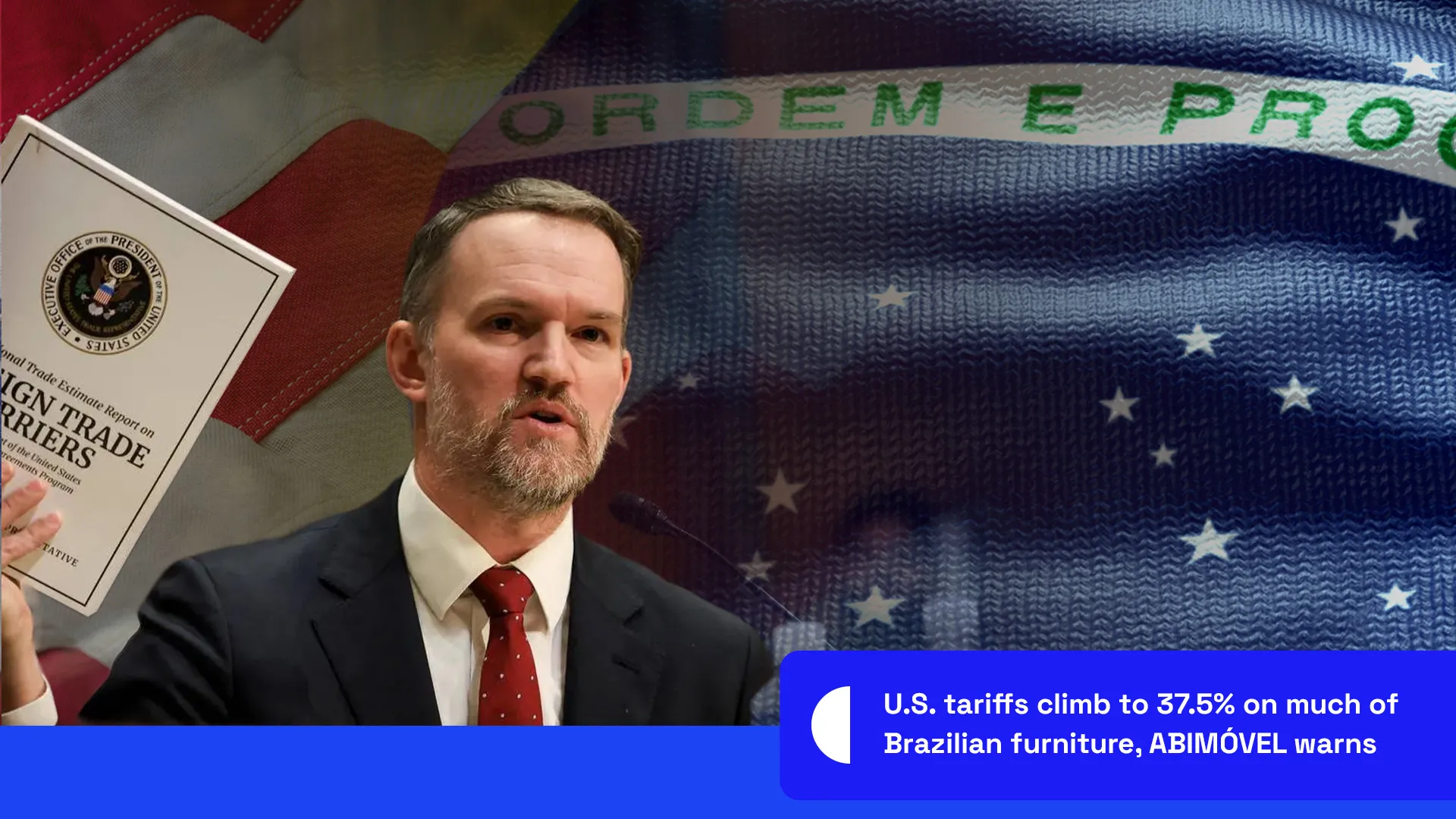
U.S. tariffs climb to 37.5% on much of Brazilian furniture, ABIMÓVEL warns

New 12.5% tariff took effect Friday, July 24, on top of a 25% duty already in force for many products; ABIMÓVEL calls for continued diplomatic negotiations, export support and measures to preserve the industry’s competitiveness

The United States has imposed an additional 12.5% tariff on Brazilian goods, further increasing trade pressure on Brazil’s furniture industry. The measure took effect at 1:01 a.m. Brasília time on Friday, July 24, and is expected to apply to approximately 3,000 products imported from Brazil, including a significant share of furniture and mattresses, as well as certain components and industrial inputs.

The new tariff stems from a second investigation conducted by the Office of the United States Trade Representative (USTR) under Section 301 of the U.S. Trade Act. According to the agency, Brazil does not have mechanisms considered sufficient to prohibit and enforce restrictions on imports of goods produced, in whole or in part, using forced labor in other countries.

The investigation covered 60 economies. USTR established a 10% tariff for 17 trading partners — including Argentina, Canada, India, Mexico and the United Kingdom — based on existing measures or commitments related to banning imports linked to forced labor.

Brazil was placed among the economies subject to the 12.5% rate, which applies to most of the countries reviewed. Other trading partners, including the European Union, Taiwan, Japan, South Korea and Switzerland, are subject to specific arrangements that take their regular U.S. import tariff rates into account.

The decision does not amount to an allegation that Brazil’s furniture industry uses forced labor. Rather, it is a countrywide trade measure based on the U.S. government’s assessment of Brazil’s mechanisms for controlling imports entering its own market.

The Brazilian government rejected the U.S. findings, describing the measure as arbitrary and unjustified. It also said it intends to challenge the action through the World Trade Organization’s dispute-settlement system and may initiate procedures under Brazil’s Economic Reciprocity Law — adding another layer of uncertainty for the industry.

How the new tariffs apply

The temporary 10% global tariff imposed by the United States under Section 122 expired early Friday, July 24. At the same time, the new 12.5% tariff resulting from the forced-labor investigation took effect.

For a range of Brazilian products, the 12.5% duty is added to a separate 25% tariff that took effect Wednesday, July 22, following another U.S. investigation. Where both measures apply, the combined additional tariff reaches 37.5%.

The applicable rate therefore depends on each product’s tariff classification:

Products covered by both measures: subject to 37.5% in additional tariffs — 25% under the first action plus 12.5% under the new measure.

Products exempt from the 25% tariff but not from the new action: subject to the additional 12.5% tariff.

Products covered by specific tariff regimes: remain subject to their respective rules and may be excluded from the new 12.5% duty, as is the case for certain products already covered under Section 232.

These rates are additional to the regular U.S. import duty applicable to each HTSUS classification. As a result, the total customs burden may be higher depending on the product.

The decision also establishes a transition rule for goods that had already been loaded at the port of origin and were in transit on the final mode of transportation before the measure took effect. To qualify, merchandise must be entered for consumption or withdrawn from warehouse before 1:01 a.m. Brasília time on July 28. Eligibility should be assessed on a case-by-case basis.


Impact on furniture, mattresses and raw materials

The U.S. decision follows a broad approach: products originating in the countries covered by the measure are subject to the tariff unless they are expressly exempted.

Because most tariff codes covering furniture and mattresses are not included among the exemptions applicable to Brazil, numerous product categories are now subject to the new 12.5% duty. The measure also reaches certain components and inputs used by the furniture industry, depending on their tariff classification.

Some upholstered furniture with wooden frames — including certain sofas, armchairs and chairs — as well as kitchen cabinets, bathroom vanities and certain cabinet parts are already covered by a separate Section 232 tariff regime. When properly classified under the applicable tariff codes, these products are expected to be exempt from the new 12.5% tariff.

That does not mean they are free from additional duties. These categories remain subject to the 25% Section 232 tariff, in addition to any other applicable charges.

ABIMÓVEL cautions that tariff exposure must be reviewed individually based on the HTSUS code used for importation, the product’s technical description, the materials involved and any specific trade regime that may apply.

In its final action, USTR also added 471 products to the exemption list, including certain raw materials and wood products. The decision references submissions indicating that some types of wood — including eucalyptus and certain derivatives — are not produced in sufficient quantities in the United States to meet domestic demand.

The measure, however, does not create a blanket exemption for eucalyptus, eucalyptus-derived products or other goods across the supply chain. Eligibility still depends on whether the product is classified under one of the tariff codes expressly listed in the decision.

Related: New U.S. tariff takes effect as ABIMÓVEL steps up engagement with Brazilian government to mitigate impact on furniture industry

Additional pressure on Brazil’s furniture industry

The latest measure deepens pressure on an industry already experiencing a sharp decline in shipments to the United States, historically the Brazilian furniture sector’s largest export market.

From January through May 2026, Brazilian furniture exports to the U.S. fell 41.7% compared with the same period in 2025. The U.S. share of Brazil’s furniture exports dropped from 27.8% to 17.4% over the same period.

Since the first tariff increases were introduced in 2025, more than 10,000 jobs have already been affected across Brazil’s furniture industry.

The sector comprises approximately 22,800 companies and 287,200 direct jobs. In 2025, Brazilian manufacturers produced an estimated 434.7 million furniture units, representing approximately R$ 92.1 billion in production value, while furniture and mattress exports totaled US$ 769.3 million.

According to ABIMÓVEL President Irineu Munhoz, the horizontal nature of the U.S. action fails to reflect the specific characteristics of Brazil’s furniture industry.

Irineu Munhoz
Irineu Munhoz
President of ABIMÓVEL
Applying a broad measure of this kind disregards the characteristics of Brazil’s furniture industry, its commitment to the legal origin of raw materials, traceability and sustainability, as well as compliance with labor, social and environmental regulations.
— Irineu Munhoz

Higher tariffs are expected to put additional pressure on prices and margins, lead to contract renegotiations, reduce orders and shipment volumes, and affect long-standing commercial partnerships.

Irineu Munhoz
Irineu Munhoz
President of ABIMÓVEL
These effects are damaging not only to Brazilian exporters, but also to U.S. importers, distributors, retailers and consumers, affecting business relationships that have been built over decades.
— Irineu Munhoz

Industry advocacy and measures needed

ABIMÓVEL continues to engage with Brazil’s federal government, advocating for continued diplomatic negotiations with the United States and seeking appropriate treatment for the Brazilian furniture industry.

During meetings in Brasília, ABIMÓVEL’s president presented the sector’s main priorities for strengthening exports and industrial competitiveness to Minister of Development, Industry, Trade and Services Márcio Fernando Elias Rosa and Foreign Trade Secretary Tatiana Prazeres.

Among the measures considered a priority by the industry are:

— continued diplomatic negotiations aimed at reviewing the tariffs and adding furniture-sector products to the exemption lists;

— full restoration of Brazil’s Reintegra export tax-refund program, including application of the maximum rate and unrestricted access;

— expanded credit and export-financing instruments;

— measures to reduce competitive asymmetries and provide companies with greater predictability;

— stronger trade-defense mechanisms and closer monitoring of imports from China, particularly given the risk that products displaced from the U.S. market could be redirected to Brazil;

— diversification of export destinations and continued efforts to open new markets; and

— a careful assessment of any retaliatory measures to prevent unintended consequences for raw materials, components, machinery and technologies used by Brazilian manufacturers.

At this stage, ABIMÓVEL Executive Director Cândida Cervieri recommends that companies conduct a detailed review of their U.S. tariff exposure.

Cândida Cervieri
Cândida Cervieri
Executive Director of ABIMÓVEL
Companies should review their tariff classifications and cross-check them against the list of products subject to the specific additional 25% tariff applied to Brazil. From there, they should confirm the treatment applicable to each product, assess shipments currently in transit and maintain close communication with their importers and customs advisers.
— Cândida Cervieri

She also urged exporters to reassess the economics of their U.S. operations under multiple scenarios.

Cândida Cervieri
Cândida Cervieri
Executive Director of ABIMÓVEL
Companies should recalculate their landed costs under different tariff scenarios — 12.5%, 25% and a potential cumulative rate of up to 37.5% — and evaluate how each scenario affects their competitiveness
— Cândida Cervieri

ABIMÓVEL will continue monitoring developments with technical support from BMJ Consultores Associados, under the leadership of international trade specialist Welber Barral. The association will also continue providing guidance to companies and engaging with Brazilian authorities and international partners to defend production, investment, employment and the global positioning of Brazil’s furniture industry as a reliable supplier aligned with international regulatory and compliance standards.

USTR decision:
Read the full USTR decision.

FURNITURE: IT’S OUR BUSINESS!

Brazilian Association of Furniture Manufacturers — ABIMÓVEL
Press Office: press@abimovel.com | +55 14 99156-0238

SUPPORTERS