



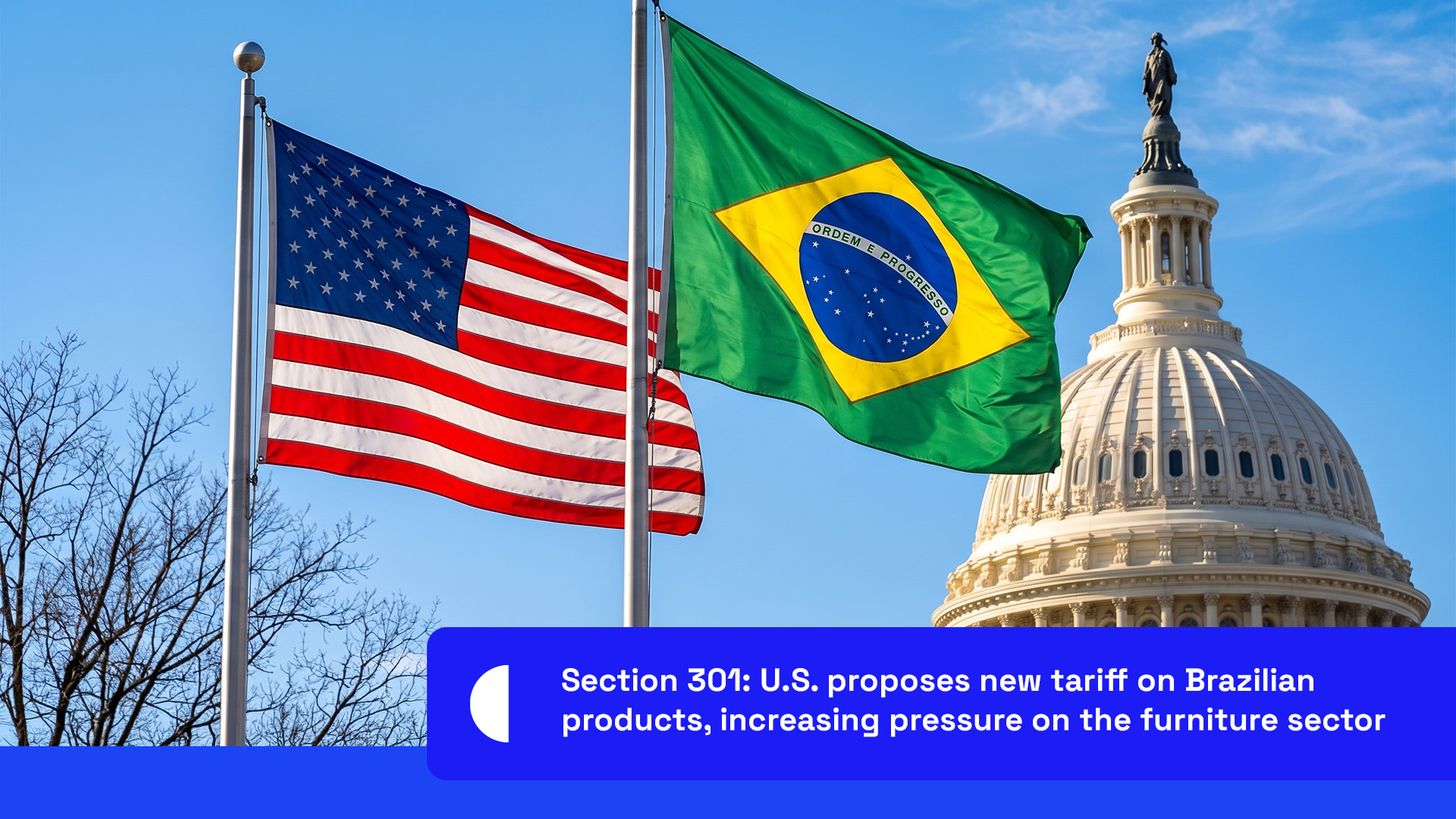
USTR has concluded its Section 301 investigation into Brazil and proposed an additional 25% tariff on a range of Brazilian goods. The measure is not yet in force, but it requires close attention from exporters. Wooden furniture is specifically mentioned under the illegal deforestation issue, raising concerns for the sector.
The Office of the United States Trade Representative (USTR) concluded, on June 1, 2026, its investigation into Brazil under Section 301 of the Trade Act of 1974. According to the agency, certain policies and practices adopted by Brazil burden or restrict U.S. commerce. In response, the United States proposed an additional 25% tariff on Brazilian goods, with exemptions still under review during the public comment phase.
At this stage, the measure does not mean the tariff will be automatically applied. The process now enters a decisive phase, and ABIMÓVEL (Brazilian Furniture Industry Association) is monitoring the official timeline and working to submit a technical and institutional statement in defense of Brazil’s furniture sector, under the legal coordination from international trade specialist Welber Barral and BMJ – Associated Consultants. A public hearing is scheduled for July 6 in Washington, D.C., and the final decision must comply with the statutory deadline of July 15, 2026.
Launched in July 2025, the investigation examined Brazilian practices across six areas: digital trade and electronic payment services, including Pix and preferential tariffs; anti-corruption enforcement; intellectual property protection; ethanol market access; and illegal deforestation. In USTR’s view, certain acts, policies and practices adopted by Brazil are “unreasonable” or “discriminatory” and impose burdens or restrictions on U.S. commerce.
How this may affect the furniture sector
For the Brazilian furniture industry, the key point is clear: although furniture is not the central focus of the dispute, wooden furniture is expressly mentioned in the official document under the section related to illegal deforestation and wood-origin products.
In addition, the proposed tariff may affect other Brazilian manufactured goods that are not included in the exemption list. This requires careful analysis of tariff classifications, ongoing contracts and commercial strategies for the months ahead.
For ABIMÓVEL, the concern is that a dispute rooted in broader Brazil-U.S. trade and regulatory issues may have concrete effects on industrial sectors that are not at the political center of the case. In furniture, attention should be focused on three main fronts: possible tariff exposure for non-exempt product lines; growing requirements to prove legal wood origin and environmental compliance; and commercial uncertainty in negotiations with U.S. importers, distributors, retailers and specifiers.
The USTR document refers to the need to assess the extent to which Brazilian products, including lumber and wooden furniture, may be made with illegally harvested timber and exported to the United States or other markets. This wording makes raw-material traceability and origin documentation even more sensitive for manufacturers and exporters, particularly in a market already regulated by instruments such as the Lacey Act, which requires declarations for certain plant-based and wood-derived products entering the United States.
This issue is especially relevant because part of the recent debate around wooden furniture in the U.S. market has already been shaped by measures linked to Section 232. The proposed exemption reduces the risk of cumulative tariffs between Section 301 and Section 232 for items already covered by the latter, but it does not eliminate the broader pressure. Products outside the exemption list, lines with different tariff classifications and items made from other materials still need to be assessed on a case-by-case basis.
The concern is further amplified by the historic importance of the United States for Brazilian furniture exports. In 2025, Brazil exported US$ 769.3 million in furniture and mattresses, up 0.8% from 2024, but below the sector’s expectations. During the same period, the U.S. share of Brazilian furniture and mattress exports fell to 23.5%, after years of operating close to or above 30%, reflecting greater caution, contract renegotiations and a shift in destination markets following the broader tariff environment.
The broader trade discussion
Section 301 is a tool under U.S. trade law that allows USTR to investigate practices by foreign governments that are considered unjustifiable, unreasonable, discriminatory or harmful to U.S. commerce. If the investigation concludes that such practices exist, the U.S. government may adopt responsive measures, including additional tariffs, trade restrictions or other forms of economic pressure.
In Brazil’s case, USTR’s decision raises concerns across several areas, including Pix and electronic payment services, decisions involving digital platforms, Brazil’s preferential trade arrangements with other countries, anti-corruption mechanisms, intellectual property protection, ethanol and environmental enforcement.
For ABIMÓVEL, it is important to separate the broader political and trade debate from the practical effects that may fall on industry. Although the proposed 25% tariff is still under public review, it already creates uncertainty for exporters, importers, distributors and buyers in both Brazil and the United States. In sectors facing tight margins and contracts negotiated well in advance, tariff risk can affect pricing, delivery schedules, future orders and purchasing decisions.
That was the same mechanism used, for example, to justify tariffs on steel and aluminum, based on the argument that excessive dependence on foreign suppliers could weaken strategic sectors of the U.S. economy.
Where furniture appears in the official USTR document
| Section of the document | How furniture appears | Reading for the furniture sector |
|---|---|---|
| Illegal deforestation issue, in the opening of the investigation | USTR mentions “lumber and wooden furniture” when referring to the extent to which Brazilian products may be made with illegally harvested timber and exported to the United States or other markets. | This is the most relevant reference for the sector. It places wooden furniture within the environmental and documentation scope of the investigation. |
| Annex of excluded products — mountings, fittings and similar articles | The annex refers to “mountings, fittings and similar articles, suitable for furniture,” under HTSUS codes 8302.42.30 and 8302.42.60, with scope limited to aircraft. | This does not refer to residential or commercial furniture in general, but to specific components and fittings. The exclusion is limited to aircraft-related applications. |
| Annex of excluded products — aircraft seats | HTSUS codes 9401.10.40 and 9401.10.80 refer to seats of a kind used in aircraft, upholstered in leather or other materials. | The exclusion applies to aircraft seating, not to residential, contract, office or décor seating. |
| Annex of excluded products — metal furniture | HTSUS code 9403.20.00 refers to “furniture, other than seats, of metal,” with scope limited to aircraft. | The reference is restricted to metal furniture used in aircraft. It does not indicate a broad exclusion for metal furniture in general. |
| Annex of excluded products — reinforced or laminated plastic furniture | HTSUS code 9403.70.40 refers to furniture of reinforced or laminated plastics, excluding seats and items under heading 9402, with scope limited to aircraft. | This is a technical and sector-specific exclusion that requires classification and application analysis. |
| Annex of excluded products — other plastic furniture | HTSUS code 9403.70.80 refers to furniture of plastics other than reinforced or laminated plastics, excluding seats and items under heading 9402, with scope limited to aircraft. | This also does not represent a general exclusion for plastic furniture. It applies to the aircraft-related scope described in the annex. |
Posição da ABIMÓVEL
ABIMÓVEL believes the sector’s response must combine trade diplomacy, technical documentation and market intelligence. The association will continue working in coordination with public and private partners, including government bodies, specialized consultants and exporting companies, to support institutional statements, monitor the evolution of the exemption list and follow the applicable tariff classifications.
In doing so, ABIMÓVEL seeks to ensure that Brazil’s furniture industry is assessed based on evidence. The association’s position takes into account the sector’s predominant use of legal raw materials, planted forests, regulated forest management, auditable industrial processes and increasingly robust standards of origin and compliance. These elements demonstrate the productive responsibility of the Brazilian furniture industry and its relevance to a balanced trade relationship with the United States.
The association will continue monitoring the process and informing the sector of new developments, particularly regarding the exemption list, the public hearing and USTR’s final decision. The goal is to ensure that business leaders have qualified information to support commercial decisions, preserve strategic markets and strengthen the position of Brazilian furniture in an increasingly demanding, regulated and competitive global landscape.
About ABIMÓVEL
The Brazilian Furniture Industry Association — ABIMÓVEL — has been working for nearly five decades to defend, develop and strengthen Brazil’s furniture value chain. The association promotes a positive agenda for the sector, supporting more than 22,800 companies that generated over R$ 92.1 billion in business in 2025 and 287,200 direct jobs, within a productive chain that employs around 1.1 million workers indirectly. Throughout its history, ABIMÓVEL has led a series of programs and initiatives focused on business development, competitiveness, design, sustainability, technical standardization, innovation and the internationalization of the industry, helping expand the positioning of Brazilian furniture both domestically and globally. Brazil is currently the largest furniture producer in Latin America and the seventh largest in the world — a position that reflects the strategic relevance of a diverse, widespread and market-connected productive chain.
abimovel.comFURNITURE: OUR BUSINESS!
Brazilian Furniture Industry Association – ABIMÓVEL
Press Office: press@abimovel.com | +55 14 99156-0238