



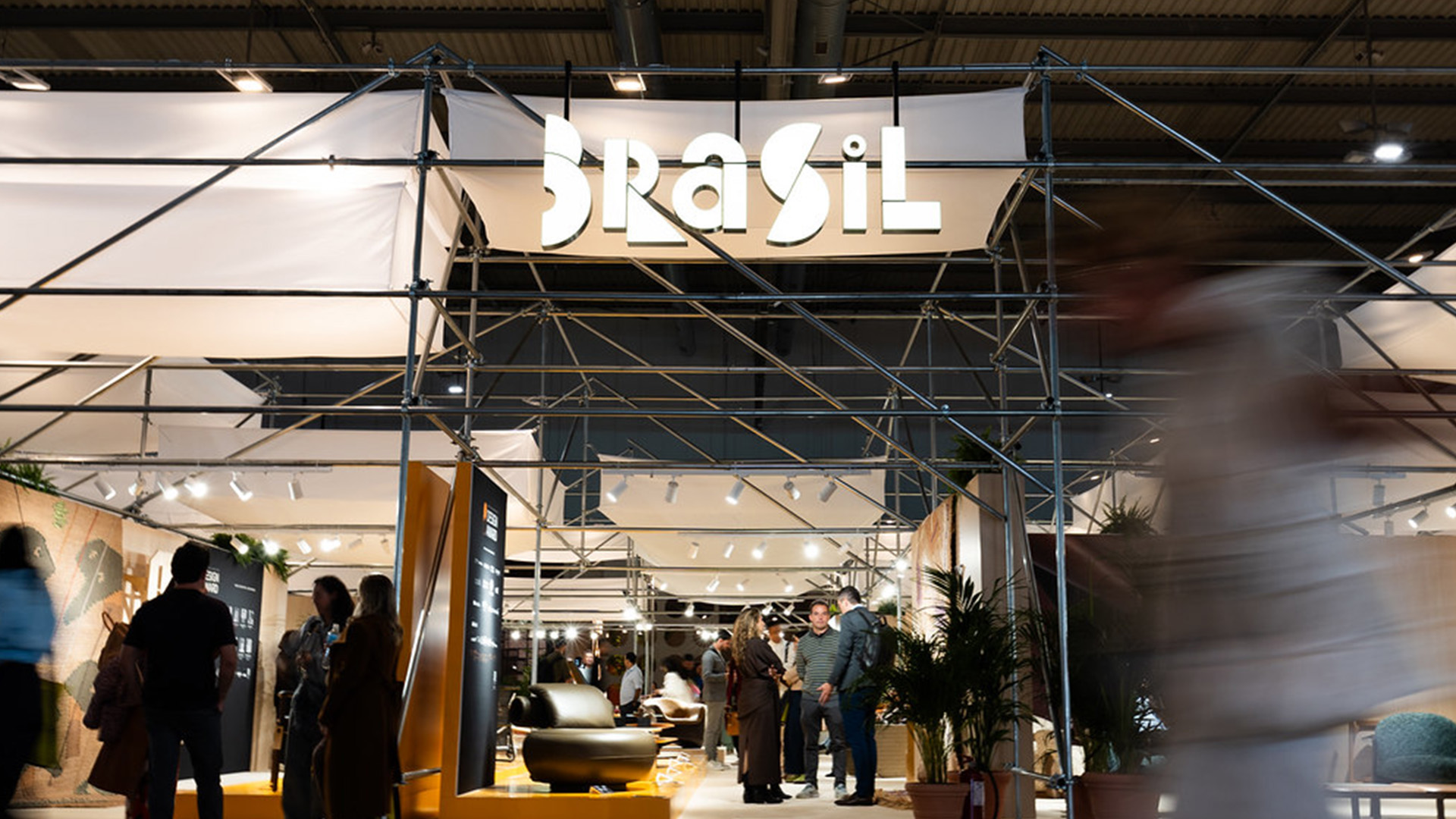
The Brazilian Furniture Project brought more than 70 Brazilian names and brands to this year’s event — and the doors to the next edition are already open: winners of the 2nd Brazilian Furniture Design Award will be exhibited at iSaloni 2027; applications are open until June 3 at mkt.abimovel.com/premiodesign
Salone del Mobile.Milano does not end when the pavilions empty out. For the furniture industry, iSaloni — the leading event of Milan Design Week in Italy — works as an expanded laboratory for the market: a place to observe which materials are gaining ground; how ways of living, hosting and working are changing; which design languages are moving forward; which narratives are losing strength; and how the global industry is seeking to respond to all of this.
In 2026, the event took place from April 21 to 26, with Brazil once again present through initiatives organized by ABIMÓVEL (Brazilian Furniture Industry Association) in partnership with ApexBrasil (Brazilian Trade and Investment Promotion Agency) under the Brazilian Furniture Project. The country’s presence brought together, across dedicated spaces in the main fair, EuroCucina and the International Bathroom Exhibition, from established companies with an international footprint to emerging talents and design students.
More than 70 Brazilian brands and creative professionals were on display. Yet the core of Brazil’s participation was not only the size of the delegation or its presence across different pavilions. It was, above all, the way the country presented itself under the theme “Connections”: as a productive chain capable of articulating industry, design, raw materials, technique, sustainability, cultural repertoire and market vision.
The Brazilian Furniture Project brought more than 70 manufacturers, designers and students to Salone del Mobile.Milano 2026, with initiatives across three pavilions.
The Major Numbers Behind iSaloni 2026
The 64th edition of iSaloni welcomed more than 316,300 visitors from 167 countries, a 4.7% increase over the previous year, with 1,900 exhibiting brands, more than 6,000 members of the press, and an audience made up primarily of international professionals — 68% of visitors were buyers, specifiers, investors, retailers and other B2B operators.
These are not just figures of scale. They indicate where decisions are being made. In a global landscape marked by trade tensions, rising regulatory demands and shifts in consumer behavior, Milan reaffirmed its role as a territory of exposure, dialogue and competitiveness. Being there means being seen by those who buy, specify, distribute, invest, publish and shape the direction of markets.
This is where Brazil’s presence gains even greater meaning. Brazil ranked as the 4th country with the largest presence of qualified operators at Salone 2026, behind China, Germany and Spain, and ahead of traditionally strong markets within the European circuit. The figure points to something beyond visitor circulation: it shows a country closely following the sector’s main forums and consistently seeking to occupy the spaces where reputation and business meet.
In this sense, Milan works both as a mirror and a platform. A mirror, because it reveals the level of demand in the global market. A platform, because it allows the industry to present its responses, expand connections and turn presence into positioning.
And what Brazil brought to Milan this year was not merely a selection of products, but an interpretation of the country itself. A country that produces at scale, but also develops language; that works with different raw materials, technologies and finishes, but also goes beyond the material; that recognizes its cultural heritage, but does not limit itself to repeating symbols; and that understands design as an instrument of competitiveness, differentiation and presence.
What Milan Pointed to as a Trend, Brazil Already Translates Into Repertoire
Across the iSaloni pavilions and the Fuorisalone activations, what emerged this year was a market less interested in isolated objects and more attentive to systems of use, atmosphere, experience and, importantly, origin.
In this sense, the concept of the 2026 edition, “A Matter of Salone,” placed raw materials as a starting point for discussing form, memory, transformation, impact and meaning. This shift is relevant because it moves the focus away from the finished object and toward everything that constitutes it: the origin of the material, the production process, technical intelligence, durability, texture, surface, shape, the relationship with space and the storytelling behind each piece.
Among the trends observed, expressive surfaces gained relevance, as did the return of finishes with shine and visual presence, more robust tables, pieces with greater formal density, striking wall coverings and a renewed attention to the tactile dimension of materials. Experts highlighted the return of lacquered finishes, tables with sculptural character, the updating of tubular chairs, and the use of boiserie, textiles and coverings as architectural elements capable of defining the atmosphere of interiors — pushing back against the minimalist approach that had shaped interiors for many years and reinforcing the timelessness of certain design elements.
Others also pointed to movements that help define the spirit of the edition: the use of more vibrant colors, weaving and braiding moving beyond decoration to assume a structural role, stone as an architectural language, the return of handcraft, and the advance of an outdoor aesthetic incorporated into indoor environments. Glass was also highlighted as one of the materials to watch this season, explored for its ability to work with light, imperfection, transparency and the memory of process.
These trends resonate directly with Brazilian industry. If Milan placed braided fibers, texture, surface, shiness, natural materials and handcraft at the center of the discussion, Brazilian exhibitors responded with a production that already carries these elements within its own matrix.
This response, therefore, did not appear as a literal translation of trends, but as convergence: Brazil presented products and collections that speak to the integration of environments, physical and visual comfort, expressive materiality and the need to create spaces that are less neutral and more connected to real ways of living.
In terms of materials and processes, several paths stood out. There were woods shaped through designs that balance lightness and presence; weaves, ropes and textiles explored not only as finishes, but as visual and tactile structures; surfaces that reinforce the relationship between touch, light and perception; as well as solutions aimed at indoor-outdoor living — one of the strongest themes of the edition and an essential part of Brazil’s living culture, marked by integration, warmth, sophisticated informality and the flow between indoor and outdoor spaces.
Brazilian Exhibitors
The pieces presented by Brazilian exhibitors in Milan revealed a convergence between global trends and national repertoire: expressive materiality, weaves, textures, crafted surfaces, comfort, fluidity between environments and attention to everyday use. More than following market movements, the Brazilian industry showed how many of these codes are already part of its way of producing, designing and living.
These characteristics were evident at Lounge Brasil, located in Pavilion 03, a meeting and networking space where the theme “Connections” took shape through exchanges among exhibitors, buyers, authorities, press and partners.
Brazil’s Consul General in Italy, Ambassador Hadil da Rocha Vianna
The Brazilian Furniture Project’s institutional agenda included a visit by Brazil’s Consul General in Italy, Ambassador Hadil da Rocha Vianna, to the Brazilian spaces.
At Espaço Brasil in Pavilion 03, the Exhibition of Brazilian Brands and Products presented the diversity of the country’s production across materials, uses and design languages. Brazil’s presence at EuroCucina, in Pavilion 02, and at the International Bathroom Exhibition, in Pavilion 10, expanded this approach into categories where functionality, technology, finishing and user experience are becoming increasingly relevant.
Marel • EuroCucina
Marel’s setting at EuroCucina 2026 presents the kitchen as a space for gathering and material expression, bringing together finish, proportion and functionality in a contemporary reading of living.
ZEN Design • International Bathroom Exhibition
At the International Bathroom Exhibition, Zen Design presented a Brazilian perspective on one of the most sensory spaces in contemporary living: solutions in which finish, proportion, functionality and user experience come together to transform the bathroom into a space of well-being, care and material expression.
Proposals associated with circularity and the bioeconomy also gained emphasis, as seen in pieces presented by highlights of the 1st Brazilian Furniture Design Award, whose innovations were showcased at iSaloni 2026 in Pavilion 03.
1st Brazilian Furniture Design Award Exhibition - iSaloni 2026
At the Exhibition of the Winning Pieces from the 1st Brazilian Furniture Design Award, the selected pieces emerged as a field of response — and provocation — to issues already shaping the present: emergency design, circularity, bioeconomy, new uses, impact and productive viability. Together, the pieces showed that innovation also means imagining new ways to produce, occupy, repurpose and live.
International interest in pieces with a sculptural presence also found a counterpart in Brazilian production. The press highlighted the Design + Industry Showcase, in Pavilion 03, emphasizing the connection between manufacturers and designers who bring together elements of Brazilian culture — from North to South, from dance to martial arts — with innovative systems and solutions for furniture.
Design + Industry Showcase — iSaloni 2026
At the Design + Industry Showcase, what was on display was also the path toward the final product: encounters between repertoires, factory decisions, creative gestures, production capabilities and new possibilities of form, use and language. A snapshot of Brazilian design as a collective construction, shaped by the different experiences, cultures, tastes, habits and biomes of each region.
This connection between Brazilianness, diversity, movement, flexibility and use reflects a sensibility very close to what the market has begun to seek: furniture capable of moving beyond the position of a static object and becoming a living element within the space. In other words, Brazilian design does not need to explain itself only through exuberant forms or direct references to territory. It can assert itself through the way it transforms matter into experience, process into value, identity into solution, and industry into language.
In a world saturated with similar global vocabularies, this ability to produce difference with consistency is relevant. Having a distinct aesthetic is not enough. It must become a viable product.
SAVE THE DATE - iSaloni 2027: April 13–18
The post-Salone moment leaves the sector with an objective outlook: being present in the major international design circuits is not a one-off promotional gesture. It is part of a long-term strategy for Brazilian design and industry to be recognized for what they are able to build together — product, value, image, market and future.
This path, in fact, is open to companies and professionals of all sizes and from every region of the country. Applications for the 2nd Brazilian Furniture Design Award are open until June 3, 2026, and the winners will have their pieces exhibited at iSaloni 2027. Read the rules and apply: mkt.abimovel.com/premiodesign.
Brazilian Furniture Project
The Brazilian Furniture Project is an initiative by ABIMÓVEL in partnership with ApexBrasil, created to increase the participation of Brazil's furniture industry and production chain in the international market through a set of strategic actions built on the pillars of sustainability, competitiveness, and design integrated within the industry. Hundreds of companies are part of the project.
In the current cycle, the project's organizers are inviting not only furniture manufacturers and designers, but also component companies and industry suppliers to join Brazilian Furniture, further expanding the reach of Brazilian furniture and reinforcing the competitiveness of the Brazil brand worldwide.
To become part of the project and place your brand at the world's leading furniture industry events, visit:
brazilianfurniture.org.brAbout ABIMÓVEL
The Brazilian Furniture Industry Association (ABIMÓVEL) has spent nearly five decades supporting, developing, and strengthening Brazil's furniture production chain. The institution promotes and leads a positive agenda for the sector, benefiting more than 22,800 companies, which in 2025 generated more than R$ 92.1 billion in business and 287,200 direct jobs, within a production chain that indirectly employs around 1.1 million workers.
Throughout its trajectory, ABIMÓVEL has led a series of programs and actions focused on business, competitiveness, design, sustainability, technical standardization, innovation, and internationalization, promoting initiatives that expand the positioning of Brazilian furniture in both the domestic and global markets. Today, Brazil is the largest furniture producer in Latin America and the seventh largest in the world, a position that reflects the strategic relevance of a production chain that is diverse, capillarized, and closely aligned with market transformations.
abimovel.comAbout ApexBrasil
The Brazilian Trade and Investment Promotion Agency (ApexBrasil) works to promote Brazilian products and services abroad and attract foreign investment to strategic sectors of the Brazilian economy. To achieve its goals, ApexBrasil carries out a variety of trade promotion initiatives aimed at boosting exports and enhancing the value of Brazilian products and services abroad, such as prospecting and trade missions, business matchmaking rounds, support for the participation of Brazilian companies in major international fairs, and visits by foreign buyers and opinion leaders to learn more about Brazil's productive structure, among other business platforms also designed to strengthen the Brazil brand.
The Agency also works in coordination with public and private stakeholders to attract foreign direct investment (FDI) to Brazil, focusing on strategic sectors that contribute to the competitiveness of Brazilian companies and of the country as a whole.
apexbrasil.com.brFURNITURE: OUR BUSINESS!
Brazilian Furniture Industry Association – ABIMÓVEL
Press Office: press@abimovel.com | +55 14 99156-0238